
Purification Ceremony at Tirta Empul Temple
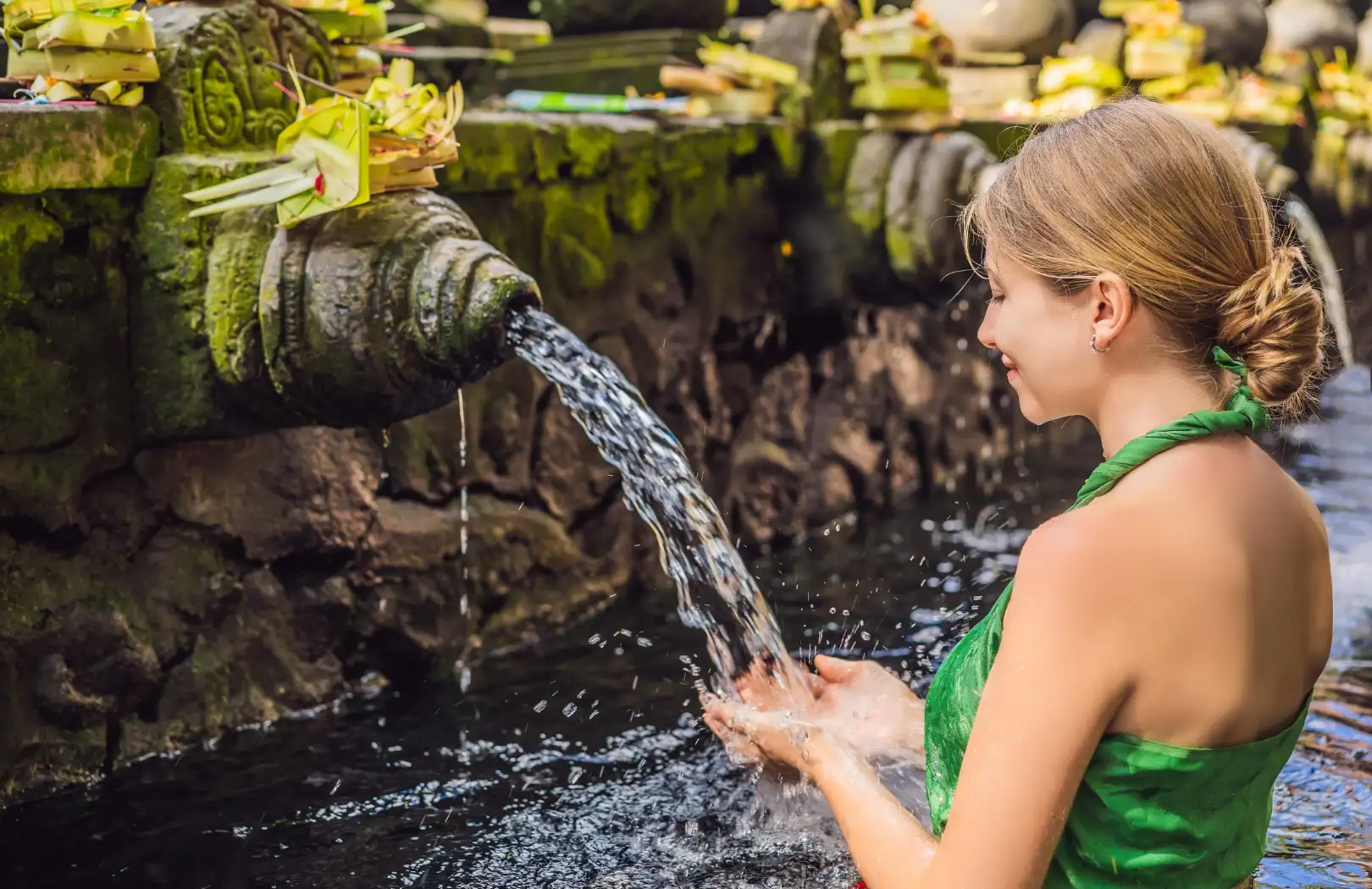
Water holds a deeply meaningful place in Balinese Hindu life. It is not only essential for everyday activities but also serves as an important spiritual element in prayers, temple ceremonies, blessings, and traditional purification rituals. Holy water, locally known as tirta, symbolizes purity, renewal, protection, and harmony between the body, mind, spirit, nature, and the divine.
One of the best-known purification traditions in Bali is called melukat. This sacred ritual is performed to cleanse a person spiritually, release negative influences, calm the mind, and restore inner balance. Balinese Hindus may take part in melukat after experiencing emotional difficulties, disturbing dreams, periods of misfortune, important life transitions, or before and after certain religious ceremonies.
Purification rituals can be performed at different sacred water sources throughout Bali, including temples, natural springs, rivers, waterfalls, and selected coastal areas. However, one of the island’s most revered places for this experience is Tirta Empul Temple in Tampaksiring, Gianyar.
The Meaning of Melukat in Balinese Hinduism
Melukat is often described as a spiritual cleansing ceremony, but its meaning goes beyond physically bathing in water. The ritual is intended to purify the unseen aspects of a person, including thoughts, emotions, intentions, and spiritual energy.
The ceremony is closely connected to the Balinese belief that harmony should be maintained between human beings, the natural environment, and God. When someone feels spiritually unsettled or affected by negative experiences, purification may be performed as a way of seeking clarity, protection, and peace.
Melukat does not replace medical or psychological treatment. Instead, it is a religious and cultural practice based on faith, prayer, sincerity, and personal reflection. Participants are encouraged to approach the ceremony with respectful intentions rather than viewing it only as a tourist activity.
Although full-moon days are considered spiritually significant and are popular times for purification ceremonies, melukat may also be performed on other appropriate days. The exact timing and procedure can depend on personal circumstances, local customs, guidance from a priest, and the sacred location being visited.
Tirta Empul Temple
Tirta Empul Temple is a sacred Balinese Hindu water temple located in the village of Manukaya, near Tampaksiring in Gianyar Regency. It is built around a natural spring whose water flows into purification pools through a series of stone fountains.
Contrary to the older blog information stating that the temple was constructed in the 17th century, official historical information connects Tirta Empul to inscriptions dating from the 10th century. A local government source refers to an inscription dated 960 AD that records an order by King Indrajayasingha Warmadewa concerning the temple’s water channels.
The name Tirta Empul is commonly understood as referring to holy water that springs or rises from the earth. The natural spring remains at the heart of the temple’s religious importance and supplies water to the bathing pools used during purification rituals.
Tirta Empul is not simply a historical attraction. It remains an active place of worship where local devotees pray, prepare offerings, collect holy water, and participate in religious ceremonies. Visitors should therefore remember that they are entering a living sacred space rather than an ordinary recreational bathing area.
The Legend of Indra and Mayadenawa
Tirta Empul is associated with a well-known Balinese legend involving the god Indra and a powerful ruler named Mayadenawa.
According to local tradition, Mayadenawa possessed extraordinary spiritual powers but became arrogant and used them for harmful purposes. He opposed religious worship and created suffering among the people. A great battle eventually took place between his forces and the army of the god Indra.
During the conflict, Mayadenawa is said to have poisoned a water source used by Indra’s soldiers. After drinking from it, many of them became weak or died. Indra then struck the ground, causing a sacred spring to appear. Its water restored his soldiers and allowed them to continue the battle.
The spring created through this divine act is traditionally associated with Tirta Empul. The legend explains why its water is viewed as a source of spiritual renewal, protection, and life. It also reflects a broader moral story about the victory of goodness, devotion, and balance over arrogance and destructive power.
The legend should be understood as part of Bali’s sacred oral tradition rather than treated as a scientifically documented historical event. Nevertheless, it remains central to the temple’s cultural identity and spiritual meaning.
Understanding the Temple Complex
Like many Balinese temples, Tirta Empul is arranged into three principal sections. These are commonly understood as the outer courtyard, middle courtyard, and innermost sacred courtyard. Archaeological information from Indonesia’s cultural heritage authority also describes the temple as being horizontally divided into three courtyards.
The first section serves as the transitional area after entering the temple complex. Visitors pass through traditional Balinese gates before reaching the central courtyard.
The middle section contains the purification pools and stone water spouts for which Tirta Empul is most famous. This is where devotees and properly prepared visitors take part in melukat.
Beyond the bathing pools is the inner courtyard, known as the jeroan. It contains sacred shrines and prayer areas used by worshippers. The official Indonesia Travel guide identifies this as the final section behind the purification pools.
Visitors who do not wish to participate in purification can still explore the temple respectfully, observe its architecture, view the sacred spring, and learn about Balinese Hindu traditions.
The Purification Pools and Water Spouts
The stone fountains at Tirta Empul do not all serve exactly the same ceremonial purpose. Certain spouts are used for general purification, while others may be connected to particular rituals, including rites that are not intended for ordinary visitors.
For this reason, participants should not simply move beneath every fountain without guidance. A local guide, temple attendant, or knowledgeable Balinese practitioner can explain where to begin, which water spouts are appropriate, and which ones should be avoided.
The purification process generally involves entering the pool in suitable ceremonial clothing and approaching the permitted fountains in the correct order. At each fountain, participants may place their hands together, focus on a sincere intention, pray, rinse the face, and lower the head beneath the flowing water.
The purpose is not to rush through the fountains or create photographs at each one. The experience should remain quiet, mindful, and respectful toward devotees who are performing genuine religious observances.
Claims that individual pools or fountains can medically cure specific diseases should be presented carefully. Within local spiritual belief, the holy water is associated with purification, protection, and healing. However, visitors should not consider it a guaranteed treatment for physical illness or mental health conditions.
Preparing for the Ceremony
A purification experience should begin with respectful preparation. Participants are normally expected to wear a sarong and sash within the temple. Different clothing may be required for entering the bathing pools, so it is best to follow current instructions from temple staff or a guide.
Bring a change of clothes, a towel, and a waterproof bag for wet items. Avoid bringing valuables into the pool area, and keep phones or cameras secure.
Before entering the water, participants may prepare a small offering and pray according to the guidance provided. The intention behind the ceremony is important. A person may focus on gratitude, emotional release, clarity, forgiveness, protection, or a peaceful new beginning.
Women who are menstruating are traditionally not permitted to enter Balinese temple grounds. Visitors should respect this religious custom even when their personal beliefs are different.
Respectful Conduct at Tirta Empul
Tirta Empul can become busy, especially around important Balinese religious days, full moons, holidays, and peak visiting hours. Arriving earlier in the day may provide a calmer experience, although religious ceremonies can take place at any time.
Speak quietly and avoid blocking pathways used by worshippers. Never stand directly in front of someone who is praying, climb on temple structures, or enter restricted areas.
Photography is generally possible in many parts of the complex, but permission and sensitivity are important. Avoid taking intrusive close-up photographs of people while they pray or purify themselves. The temple should not be treated merely as a background for social media content.
Visitors should also avoid making promises that the ceremony will remove every personal problem, illness, curse, or negative condition. Melukat is a faith-based spiritual tradition whose personal meaning depends on sincerity, belief, cultural understanding, and individual experience.
Experiencing Tirta Empul with Margaya Bali Tour
A visit to Tirta Empul provides an opportunity to understand a meaningful part of Balinese spiritual life. Beyond the beauty of its stone fountains and temple architecture, the site teaches visitors about devotion, purification, balance, and the sacred role of water in Balinese Hinduism.
Margaya Bali Tour can help arrange a comfortable private journey to Tirta Empul Temple and provide guidance on appropriate temple etiquette. The experience can also be combined with nearby attractions such as Gunung Kawi, Tegallalang Rice Terraces, traditional villages, coffee plantations, or other cultural destinations around Ubud and Tampaksiring.
Whether you participate in melukat or visit only to learn about the temple, approach Tirta Empul with humility and an open mind. The most meaningful experience does not come only from standing beneath the holy water, but from respecting the tradition, understanding its purpose, and taking time for sincere personal reflection.
Latest Article



Bali Tour Frequently Asked Questions
Margaya Bali Tour offers private Bali tour packages, Nusa Penida day trips, Mount Batur sunrise experiences, private car charter services, and one-way airport transfers with professional local drivers.
Yes. Our tours are private, allowing you to travel only with your partner, family, or group. This provides greater comfort, flexibility, and a more personalized Bali travel experience.
Yes. Private car charter services offer flexible itineraries based on your preferred destinations and booked duration. Fixed tour packages may also be adjusted when possible, depending on travel time and local conditions.
Inclusions vary by package. Most tours include private transportation, an English-speaking driver, fuel, parking fees, hotel pick-up and drop-off, and bottled mineral water. Some packages also include entrance tickets, meals, guides, or activity tickets.
Some all-inclusive packages include entrance tickets and meals, while transport-only tours may not. Please check the Include and Exclude sections of each package before booking.
Hotel pick-up is available from many popular Bali areas, including Kuta, Legian, Seminyak, Canggu, Sanur, Jimbaran, Nusa Dua, Ubud, and selected surrounding locations. Additional charges may apply for remote areas.
You can contact Margaya Bali Tour through WhatsApp and provide your travel date, hotel location, number of guests, preferred package, and any special requests. Our team will confirm availability and booking details.
Yes. We provide private one-way airport transfers between I Gusti Ngurah Rai International Airport and destinations across South, Central, North, and East Bali using small cars or Hiace vehicles.
Yes. Small cars are suitable for solo travelers, couples, families, and groups of up to four guests. Hiace vehicles are available for larger groups of approximately five to ten passengers.
Tour itineraries may be adjusted due to rain, sea conditions, traffic, temple ceremonies, or safety concerns. Our team will recommend the safest and most suitable alternative whenever possible.